

How to Choose a Light Therapy Device – Part 5: Features Are Not the Same as Engineering
When two light therapy devices appear similar, it is tempting to assume they will provide a similar experience. They may use comparable colors, advertise multiple settings, or have nearly identical housings.
But appearance and feature count do not reveal the quality of the system underneath.
A feature tells you what a device claims to offer. Engineering determines whether those features work reliably, consistently, and together as intended.
That distinction matters when choosing a light therapy system you expect to use regularly for years.
A Feature Is Only One Part of the System
A device may advertise:
- Multiple wavelengths
- Several intensity levels
- Pulsing frequencies
- Pre-Programmed Patterns
- A rechargeable battery
- A flexible or portable design
Those features may sound impressive, but they raise important follow-up questions:
- Are the wavelengths clearly identified?
- Is the output stable throughout the session?
- Are the frequencies defined?
- Do the programs have an organized structure?
- Has performance been independently measured?
- Does the battery deliver dependable power?
- Can the company explain how the system works?
Without clear answers, a feature list provides only part of the information a buyer needs.
Why Integration Matters
A photobiomodulation system is more than a group of LEDs placed inside a housing or flexible pad.
The colors, output, operating modes, controller, battery, timing options, and frequency settings must work together.
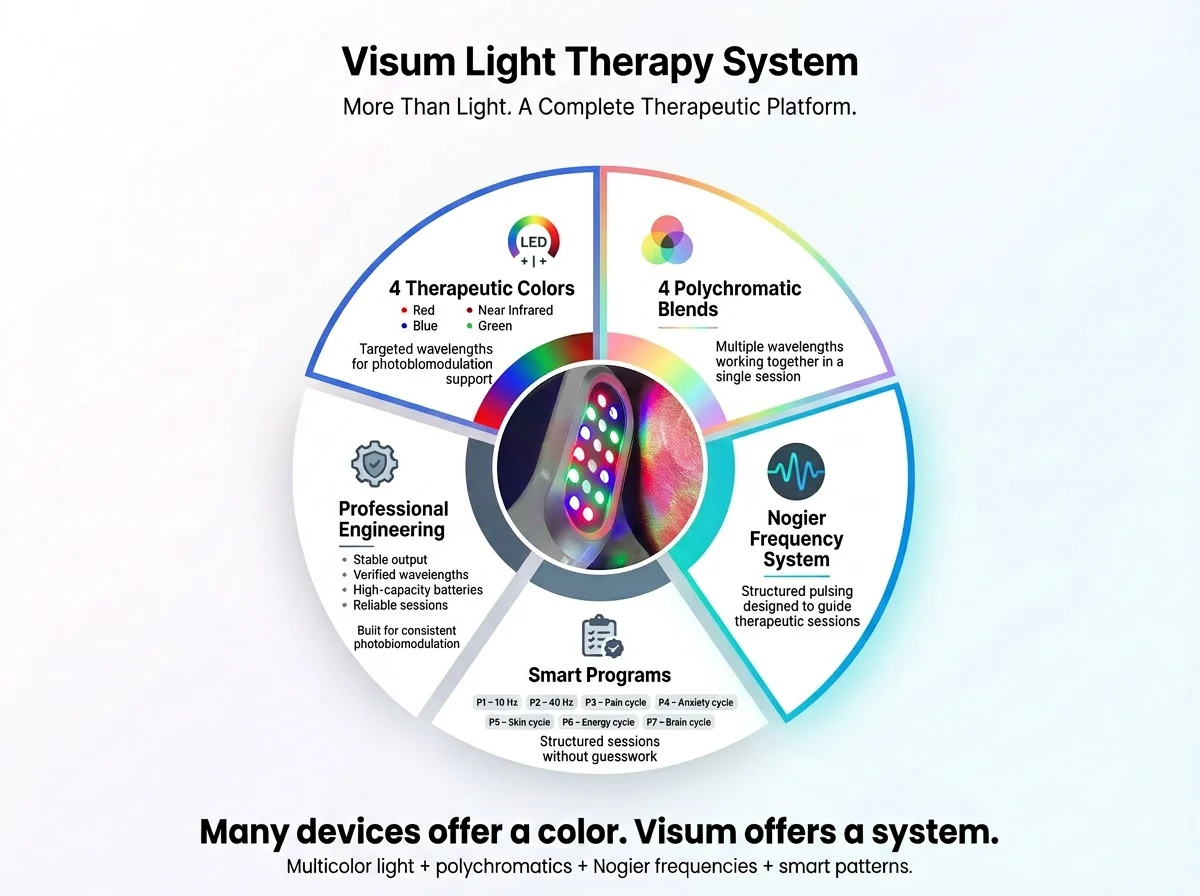
Visum Light was developed as an integrated system. Depending on the product, users have access to:
- Red, Blue, Green, and Near-Infrared light
- Blended visible-color options
- Seven Pre-Programmed Patterns
- Seven selectable Nogier Frequencies
- Continuous operation
- Direct Dosing on the Handheld
- Targeted or hands-free formats
The value comes not only from having these options, but from organizing them into tools that can be used consistently.
Stable Performance Matters More Than Peak Claims
Some manufacturers focus heavily on the highest power number a device can produce. A large number may attract attention, but it does not necessarily describe how the device performs during a complete session.
A more useful evaluation includes:
- Whether output remains stable
- Whether different settings operate as described
- Whether battery performance affects delivery
- Whether combinations behave predictably
- Whether the published information is supported by testing
More power is not automatically better. Photobiomodulation should not be evaluated by intensity alone.
A well-designed system should help users create repeatable sessions without encouraging them to assume that maximum intensity always provides maximum value.
Independent Testing Provides Evidence
Marketing claims are written by the company selling the product. Independent testing provides another level of information.
Third-party laboratory testing can help evaluate characteristics such as:
- Wavelength output
- Irradiance
- Operating behavior
- Performance under different settings
- Consistency between stated and measured specifications
Visum Light has its products evaluated by an independent light laboratory because transparency matters. Customers should not have to rely entirely on phrases such as “optimal energy delivery” or “professional-grade output” without supporting information.
When comparing products, ask whether testing was performed independently and whether the company is willing to share meaningful results.

Similar Appearance Does Not Mean Equivalent Design
Products can look alike on the outside while differing substantially in:
- Internal components
- LED selection
- Power management
- Battery capacity
- Controller programming
- Frequency structure
- Output behavior
- Quality-control procedures
Copying the appearance of an established product does not automatically reproduce the development, testing, or system knowledge behind it.
That is why buyers should evaluate what can be verified—not simply what looks familiar.
Transparency Is Part of Product Quality
A company should be able to explain:
- Which wavelengths are included
- Which frequencies are available
- What each operating mode does
- How the product was tested
- Where the product is made
- What the warranty covers
- How customers receive training and Customer Care
Vague language makes meaningful comparison difficult.
When a company cannot clearly define a claim, customers have every right to ask for clarification. If satisfactory information is unavailable, that should be a reason to pause and examine the product more closely.
What is the difference between a feature and good engineering?
A feature describes something a product offers. Engineering determines how reliably that feature operates, how it interacts with the rest of the system, and whether it provides consistent value in real-world use.
Why is stable output important?
Stable output helps create more repeatable sessions. A peak power claim does not necessarily explain how the device performs throughout the complete operating cycle.
Why does independent testing matter?
Independent testing provides objective information that can help verify wavelengths, output, and operating performance rather than relying solely on company marketing.
Can two products that look alike perform differently?
Yes. Products with similar exterior designs may use different LEDs, batteries, controllers, programming, internal components, and quality-control processes.
What should a company be able to explain about its product?
A company should be able to clearly explain its wavelengths, operating modes, frequency settings, testing, warranty, product origin, and available Customer Care.

