
How to Choose a Light Therapy Device – Part 3: Choosing the Right Tool for the Job
How to Choose a Light Therapy Device – Part 3: Choosing the Right Tool for the Job
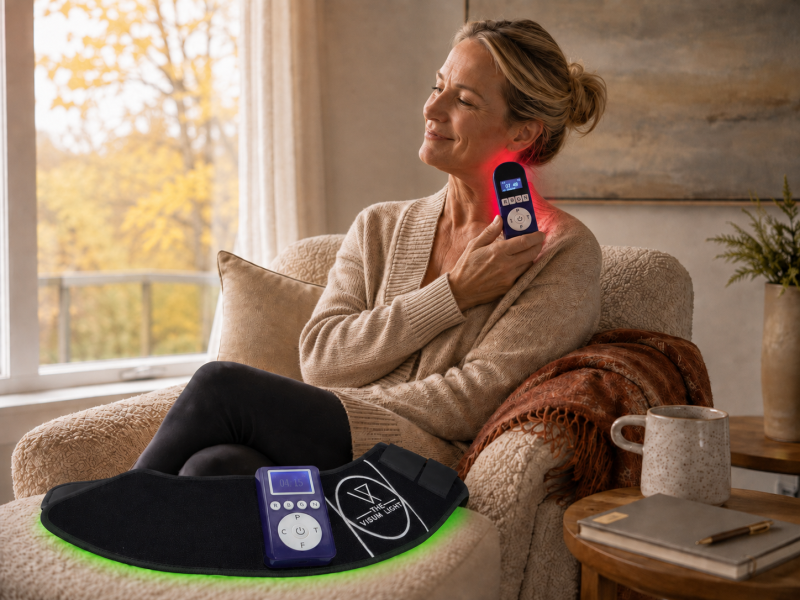
Once you understand which light therapy features matter, the next step is choosing the right style of tool.
Many buyers begin by comparing wavelengths, power levels, colors, and programs. Those details matter, but they do not answer one of the most practical questions:
How will you actually use the device?
A light therapy tool may offer impressive specifications, but it will not be useful if it is difficult to position, uncomfortable to hold, too small for the intended area, or more complicated than your routine requires.
The best choice begins with matching the tool to the application.
Precision or Coverage?
The first decision is whether you need targeted precision or broader coverage.
A Handheld device is generally best for:
- Smaller or more focused areas
- Point-specific applications
- Face and skin routines
- Hands, feet, joints, and narrow areas
- Acupoint-style applications
- Users who want adjustable intensity and Direct Dosing
- Practitioners who require more control over placement
A Flex Pad is generally best for:
- Larger areas
- Broad muscle groups
- Backs, hips, shoulders, and legs
- Hands-free sessions
- Curved or difficult-to-hold positions
- Dogs, horses, and other animals
- Users who prefer to rest while the device is operating
Neither format is universally better. They serve different purposes.
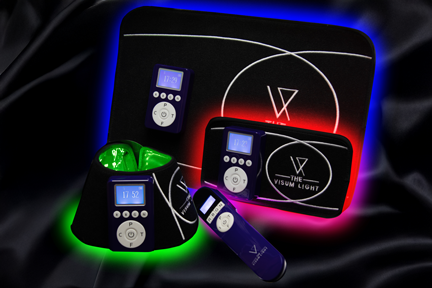
The Visum Handheld is a precision tool. The Flex Pads are coverage and positioning tools.
Choosing for People
For personal use, begin with the area you want to support.
The Handheld may be the logical choice when you want precision around a small joint, hand, foot, face, TMJ area, or point-specific location.
A Flex Pad may be better when you want broader coverage over the back, hips, shoulders, abdomen, or larger muscle groups.
The size and shape of the application area should guide the decision—not simply which product has the longest feature list.
Choosing for Animals
Animal use adds another consideration: tolerance.
Some animals relax comfortably under a flexible pad, while others prefer shorter, targeted Handheld sessions.
For dogs, Flex Pads often make sense because the animal can rest while the pad is positioned over the back, hip, shoulder, or other broad area.
For horses, Flex Pads provide practical coverage over larger areas and reduce the need to hold a Handheld throughout the session. Animals should always be supervised, and veterinary concerns should remain under veterinary care.
Why the Pain Buster Pad Is So Versatile
The Pain Buster Pad is one of the most adaptable options in the Visum Flex Pad system.
Its size offers broader coverage than a small targeted pad while remaining flexible enough to position over many different areas. It may be used on the back, hips, shoulders, larger joints, muscle groups, and many animal applications.
It also provides the full Visum Flex Pad system:
- Red, Blue, Green, and Near-Infrared light
- Blended visible-color options
- Seven Pre-Programmed Patterns
- Seven selectable Nogier Frequencies
- Continuous Mode
- Cordless, hands-free operation
The word Pain appears as part of the product and program labeling, but the pad should be understood as a wellness, comfort, and recovery-support tool rather than a substitute for medical or veterinary care.
Choose the Tool You Will Actually Use
The best light therapy purchase is not necessarily the largest, strongest, or most advanced product.
It is the one that:
- Fits the area
- Is easy to position
- Works with your routine
- Provides the level of control you need
- Can be used consistently
Choose precision when precision matters. Choose coverage when coverage makes the routine easier.
The right tool should not make light therapy more complicated. It should make consistent use more practical.

What is the main difference between the Visum Handheld and Flex Pads?
The Handheld is designed for targeted precision, adjustable intensity, and Direct Dosing. Flex Pads provide broader, flexible, hands-free coverage.
Which tool is best for a large area?
A Flex Pad is generally the better choice for broad areas such as the back, hips, shoulders, abdomen, or larger muscle groups.
Which tool is best for a small or precise area?
The Handheld is generally best for smaller joints, point-specific placement, face and skin routines, hands, feet, and other targeted areas.
Can the Handheld and Flex Pads be used together?
Yes. Many users choose the Handheld for focused applications and add Flex Pads for broader, hands-free sessions.
Which tool is best for animals?
That depends on the animal’s size, the area being supported, and how well the animal tolerates handling. Flex Pads are often practical for broader areas, while the Handheld may be useful for smaller targeted locations.
